Purpose-Driven Growth with MadTree Brewing's John FitzGerald

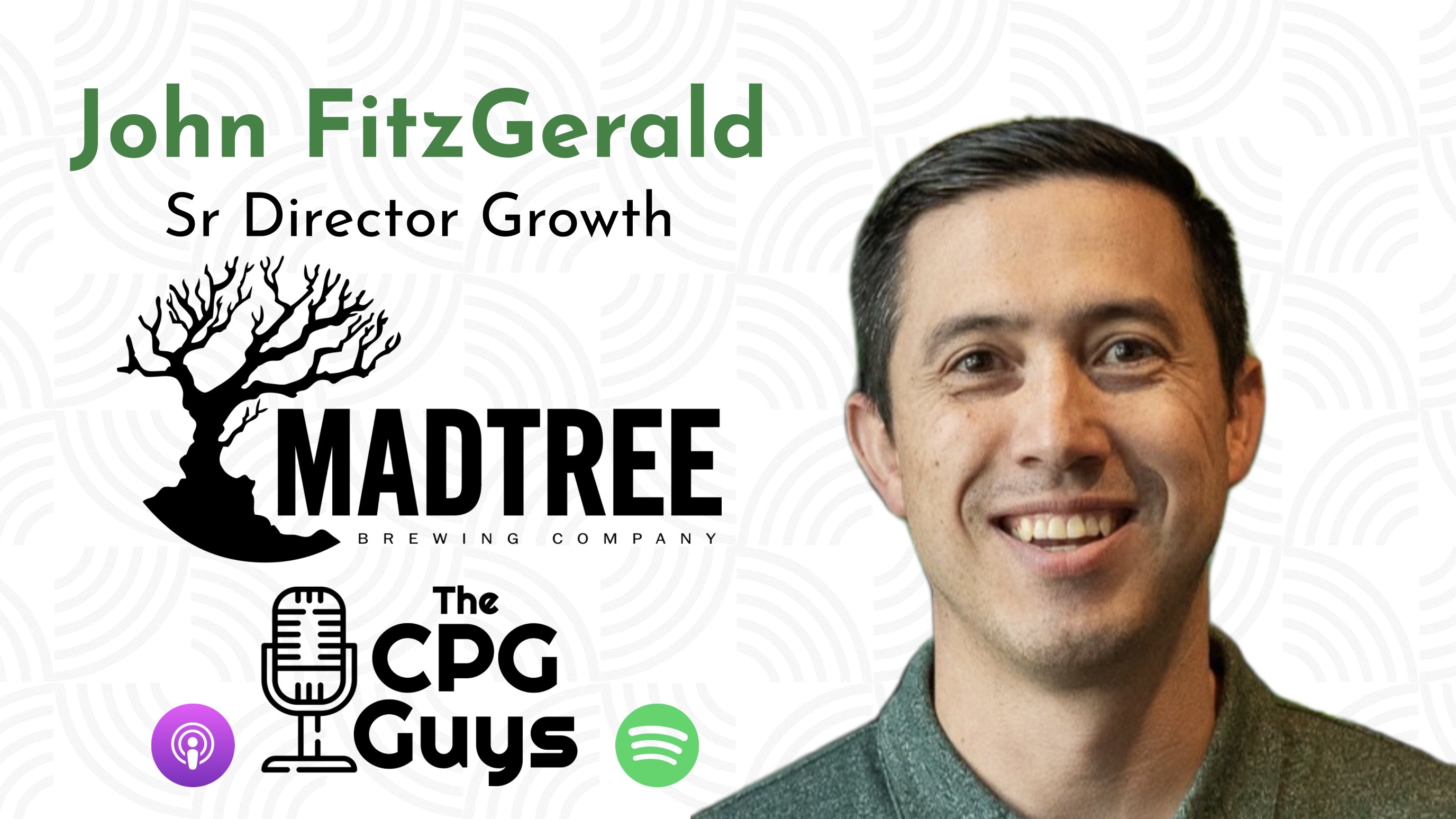








The CPG Guys are joined in this episode by John FitzGerald, Sr Director of Growth at Mad Tree Brewing Company. Founded in 2013, MadTree is an award-winning brewery that’s rooted in Cincinnati and planted in purpose. Driven to craft great beer - but more importantly - build a business dedicated to doing good, MadTree protects and celebrates nature while reducing impact on the environment. MadTree is a B-Corp certified company and proud member of 1% for the Planet with a commitment to donate 1% of sales to local, sustainable nonprofits.
Follow John on LinkedIn at: https://www.linkedin.com/in/johnwfitzg/
Follow Mad Tree Brewing online at: https://madtree.com/
John answers these questions:
- What is the one core discipline or strategic framework from that world that you’ve found most indispensable when running a craft brand like MadTree?
- How do you find the balance between Big CPG rigor and the "fail fast" agility required in the craft brewing industry?
- When you look at the beer aisle now—which is notoriously crowded and fragmented—how do you apply a "Category Management" mindset to help MadTree win at the shelf against the mega-brewers?
- How are you leveraging your background in retail partnerships to ensure MadTree isn't just a "local favorite" but a "must-have" brand for major regional retailers?
- From a leadership perspective, how do you ensure that sustainability isn't just a marketing "badge" but a functional part of your supply chain and operational DNA?
- You’re managing a complex journey between the taproom (DTC/Experience) and the grocery store (Wholesale). How do you ensure the brand "feeling" a consumer gets in the Oakley taproom translates when they are picking up a 6-pack at Kroger or Meijer?
- In craft beer, data can often be opaque. How are you building a "Full View" of your consumer, and are you leveraging tools like AI to predict the next big flavor profile or seasonal trend?
- How is MadTree evolving its product portfolio to capture that shifting demographic and maintain relevance?
- For a regional brewer, how critical is real-time inventory and sales data to your production planning, and how do you handle those "uncomfortable" supply chain moments?
- What is the biggest "reality check" you can give to someone looking to transition from a global giant like Kellanova to a high-growth local leader like MadTree?
CPG Guys Website: http://CPGguys.com
FMCG Guys Website: http://FMCGguys.com
SheCOMMERCE Website: https://shecommercepodcast.com/
Rhea Raj’s Website: http://rhearaj.com
Lara Raj in Katseye: https://www.katseye.world/
DISCLAIMER: The content in this podcast episode is provided for general informational purposes only. By listening to our episode, you understand that no information contained in this episode should be construed as advice from CPGGUYS, LLC or the individual author, hosts, or guests, nor is it intended to be a substitute for research on any subject matter. Reference to any specific product or entity does not constitute an endorsement or recommendation by CPGGUYS, LLC. The views expressed by guests are their own and their appearance on the program does not imply an endorsement of them or any entity they represent.
CPGGUYS LLC expressly disclaims any and all liability or responsibility for any direct, indirect, incidental, special, consequential or other damages arising out of any individual’s use of, reference to, or inability to use this podcast or the information we presented in this podcast.
SPEAKER_01
Hi, I'm John Fitzgerald, Senior Director of Growth at Mad Tree Brew Inc., and you're listening to the CPG Guys Podcast.
SPEAKER_02
Hello and welcome to the CPG Guys Podcast, set at the intersection of commerce and tech. Your hosts, Sri Raja Goplin and Peter V. S. Bond, explore how brands and retailers engage consumers in a digitally driven world. And now, here are the CPG Guys.
SPEAKER_00
Hello and welcome to this special episode of the CPG Guys Podcast. I'm of course Shri, your West Coast co-host and also CRO and co-founder at ThinkBlue Consulting, your trusted partner in your Omnichannel journey, where you can get in touch with me at Shree at thinkblueconsulting.co. Please listen to my younger daughter, Laura Raja, the band Katsi, who is now nominated for three AMA Awards and performing live in Las Vegas in a couple of weeks. And let's just study a Raja, former American finalist. I'm joined today by my East Coast co-host and co-founder, Peter V.S. Bano, Moonlights, the set of industry and climbing agent at Flywheel, the Commerce Acceleration Division of Omnicom. Peter, we're in the Queen City. And uh you got something special going on right here. Mad Tree won. One of yours, Peter, from past life. Tell us more.
SPEAKER_02
All sorts of stuff. Yeah, when I was living in Hyde Park East in Cincinnati from 2010 to 2014, it was right about the time that Mad Tree came into being, and they opened up uh a little uh a little brew stand, uh, which has grown into a full-scale uh uh community, is the best way to describe it. The the space is incredible, and it's uh it's just such a huge opportunity to come back, see uh a local company that's uh done very well and has become quite a re regional success. And uh I think the sky's the limit, so we're gonna explore a little more of that today, Shri.
SPEAKER_00
It should be a lot of fun and doing it in life from a brewery. It's not something I had in my bingo card for 2020 say, but here you go. So I want to thank all of you that listen to us and our sponsors. Without you, this podcast doesn't exist. Thank you, thank you, thank you. Make sure subscribing to our podcast on your preferred listening platform where you can get our latest episodes and go back to consume some of the 590 plus episodes we've already published. And I want to thank Brian Spencer for Progo Precision Marketing for being our host, having um invited us to the 8451 headquarters where we got to record two lovely podcasts which will be out shortly for you as well. Includes Helian in one of those conversations. So we look forward to that. And earlier we were at the CPD Ignite conference with the Insights Association, keynoting kicking off today as well. It's John Fitzgerald, Senior Director of Growth Marketing and Management doing a local brewery right here in C the Queen City. We're here to meet with Kroger, do a keynote with the Insights, as I mentioned this morning. We're at Nananana Northern Kentucky University, just like that in a four-hour window. John and I went back and forth on LinkedIn. We got the question set up, and this podcast is actually being executed. And John, how Christian you guys are. Man, how you doing?
SPEAKER_01
I'm doing great. It's uh exciting to be here and love how it all came together.
SPEAKER_00
In the digital show notes of this episode, we'll of course include links to John's LinkedIn profile, Mad Tree's corporate websites for our listeners to access while we go on with our conversation. So let me jump right in, John. I'm gonna straight to uh your past, PNG, Celinova. You spend years at what many call the universities of PNG, especially uh universities of CTG, especially PNG, and then Celanova. What's one core discipline or strategic framework from that world you found most indispensable when running a craft-drewing brand like Mad Tree?
SPEAKER_01
Yeah, no, it's uh one a lot of privilege to come from both of those places. Uh, I'd say the number one thing I remember is being obsessed with your customer and understanding not only why they're using your products, but the tension points that lead them there. So, really just like being obsessed with the customer, understanding, again, the valued proposition that you have, but also the valued proposition that they view that you are solving for their issues. So, really being smart about understanding those tension points, understanding those whys, digging deep into the whys, um, and really understanding that besides before just jumping into tactics or thinking that your assumptions are correct. So, really just understanding the consumers.
SPEAKER_02
Hey, John, welcome to the podcast and thank you for your incredible hospitality, taking us on a tour of the facility, giving us a little bit of the history, showing us such incredible hospitality. We could not be more appreciative. What I want to talk to you about is this concept around innovation. In your past life, particularly Procter Gamble, innovation cycles can take, frankly, not months, but years and millions of dollars in research and development. Mattree, uh, things move uh at the speed of the tap room, which can be pretty fast. How do you find the balance between kind of that big CPG rigor that PG kind of instilled into your DNA and the fast fail agility that's frankly required in in the craft brewing industry as consumer tastes and preferences change on a dime?
SPEAKER_01
Yeah, no, that uh took getting use too of we do not have an upstream team that's been working on innovation for three plus years who hands it to us to execute, right? Um if anything, it's like we have to understand the industry very well to what I just talked about. We have to really understand our consumers, not only who's coming into our spaces, but who's buying us and distribution as well. Um and I'd say the the fail fast area is with a lot of our products, we can turn those around in two to four weeks. We can get real-time feedback from our consumers in the tap room. Uh, one thing I love is like everything that's on our board, when you come to any of our spaces, is there very intentionally. And that's because we're trying to learn more about that product and how our consumers interact with that. So I think one being able to move quickly, but also being able to move principled is very important. And then just being as smart as you can with all the resources that we have. If we have data point A and B, then we can move to products and we can move to testing that. But it's important not to skip the Y and again, understanding those tensions when you're creating it.
SPEAKER_00
John, that's awesome that you know you're using old school thinking right from PNG, all the experience that you've gained in innovation today. But uh, I'd love to talk to you about category management captaincy, which you really come from, Kellanova, back in the days, serial as well as PG across the board on home and personal care. So these are massive global categories. And when you look at the PRL now, which is notoriously crowded, fragmented, how do you actually take a category management mindset where you can be a category captain to help mad free win at the shelf against the mega, mega brewers?
SPEAKER_01
Yeah, so I think that's uh one of the biggest challenges we face every day. When you look at the shelf, you see look at a the shelf is getting smaller in size. And I think it's really important of uh where we have the advantages with a lot of smaller breweries, you have the ability to affect the shelf regionally where we play. And so I think it's understanding the set, the same principles of you want to provide a set that lifts the entire category, that brings folks down the aisle, but also it's being smart about where we are and the products that we're talking about. So the shelf that I'll recommend in Cincinnati is very different than the shelf that I will recommend in Columbus or Cleveland or Lexington. Um and the mix on that is very intentional and you have to have the data that supports it. But I think that's one of the big things is obviously you want to grow the category, but you also have to provide a solution that works. And that means for your SKUs as well as for competition, being very close with the distributors as we have those conversations as well.
SPEAKER_00
Actually, one quick follow-up on that one. Is working with your distributors a different experience than you've ever done working with, you know, PG and Kelanova, where you work with retail, or does it feel the same?
SPEAKER_01
Yeah, I'd say it's a different level of partnership, right? So I'd say, you know, we have to sell to our distributors who then sell to the retailers. And we were very lucky that we have great distribution partners. Um, but at the same time, like they're also our customers. So we do have to make sure that we have the right items that fit into their portfolios that are going to fit into the retailers and that we have solutions that again help them that help them sell. So I'd say it's it's different levels for sure. Um, but you also have to be very close with the retailer and the distributor. So I'd say it's to introduce your question, yes, very different. Um, because effectively you have to make sure your product is willing to sell across all of those lenses.
SPEAKER_00
And then who takes leadership on the planogramm for retail, the distributor or you guys?
SPEAKER_01
So we will work with the distributor on having that leadership. Usually with the distributors, they have a multiple brand they work with. And so we'll provide our input, we'll have those discussions, have that level of partnership there, but ultimately they're the ones coming up with those plans.
SPEAKER_02
Obviously, John, Mad Tree is a beloved Cincinnati brand. But if you want scale, you're going to have to focus on distribution, particularly in a category which is subject to the three-tier system, which is legally mandated. The manufacturer, the distributor, and the retailer are separate entities. So my question is: how are you leveraging your background in retail partnerships to ensure that Mad Tree goes from being just a local favorite to, dare I say, a must-have brand for regional and even national brands when you get to that scale? What is it that you're bringing from your experience to help Mad Tree on that journey?
SPEAKER_01
I think what I start with always is like relationships with the buyers. And so that's not only with the distributors, but also with all of those retailers, but also with those store managers as well. So to grow at Kruger outside of really the three divisions where we play pretty strongly in now, you have to have the data that shows that at least where you are now is where you're winning, and then create that reason to believe. So I think it starts one with uh being very close with the store managers, with those who help you out with your displays. One of the big learnings that I've taken is for instance, at Cel Nova, when we're pitching our back to school buses, you get national distribution on those, your team goes, they put in the displays, they execute them, awesome, they sell. Now it's we pitch in the display, we get them, but then it comes back and you get the sheet, the planner from Kroger that now we're priority 11. And uh when I first saw that here, I was like, what on earth does priority 11 mean? And it was like, basically, you are the 11th priority. There's everyone ahead of you on who gets the displays. And if you don't have the relationships with these stored managers there, then they're not gonna help you with a winning solution to get you in there. And so it's uh making sure that my sales reps are armed with the tools and the ability to go and create those relationships. And so one, you're starting off building those buyer relationships. Now we get those displays, now we get those that incremental volume. Now you're able to have that data that provides you that reason to believe when you're looking to expand. And that's been a big part of our expansion strategy and discussions when we talk about going into new markets, specifically when we look at Cleveland, Toledo, Columbus, uh, Louisville, and Lexington. It's uh having those relationships. And then we're in when we're in those new markets, building those relationships, using the connections that we have. But I think it all comes back to you have to be on the same page with your buyer. Otherwise, it's not going to help. And it needs to be a genuine relationship as well, where there's trust and they know that you truly are working for something that's going to help everyone else.
SPEAKER_02
John, a follow-up to that, if I might. So as you look to expand into a new market, what's your lead in? Is it off-premise? Is it on-premise? Is it a concerted effort? How do you tackle entering a new market where Mad Tree doesn't necessarily have history to make sure that it's a successful launch and you're able to expand your brand franchise?
SPEAKER_01
Yeah. So I think about this like from the true Omni lens, right? Um, and I mean Omni of not necessarily just like shopping online, uh, but it really starts with the on-premises where we need to be winning because that's where we have the opportunity to drive the most trial and also the least commitment, right? Like one six or seven dollar pint is a lot less than uh one$10 to$12 six-pack or a$25,$24 pack, right? So uh making sure that we're winning on premise is how you drive that trial. And then also being very smart about how we go into these new geographic regions, even breaking down a county by the stores, by the independence, by the on-premise locations where we need to win, and then expanding that out. If we go in and just say, we need to win in Columbus. And so now we just go and throw a dartboard in Franklin County, that's not going to be a winning strategy. But if we're able to, again, like really segment that through, drive the trial where we think we have the best right to win, then we've seen that's been the best recipe for success with us so far. And uh it's been really fun to see those numbers in Columbus, really, over the last year.
SPEAKER_02
And if driving trial on premise is the goal, is part of what you're doing going in and educating the people in the in the bars where your product is first being introduced to help them understand how to talk about the beer and get people excited. Because I have to imagine the storytelling and connecting consumers to the brand is really what drives success.
SPEAKER_01
It's huge. And that's where we have to lean in on not only the product and how it's differentiated, but also the brand and how it's differentiated. And uh, you know, it's really easy in Cincinnati to tell the to tell the story of how much we put back into Cincinnati parks and uh what we mean to the Cincinnati community. But where it's really different is like, why would someone in Columbus care about that? Um, but that's where we can really lean into the B core to the 1% uh to where like you're helping out the planet when you put this mad tree. And when you talk about our differentiators of our quality lab, of our, you know, we don't go out of stock. We have, you know, our replenishment rates are super high. And so they know that they can rely on us. And that's recrafting a different story that helps differentiate your brand and help you win, again, win that keg, win that case a sway.
SPEAKER_00
That is a perfect segue to my next question, which is about community. We've uh learned that Mad Tree is a member of the 1% for the planet. What does that mean? And from a leadership perspective, how do you ensure that sustainability isn't just a marketing batch, but a functional part of your supply chain, your operational DNA for a company that works a lot with aluminum, glass, plastic, things of that name?
SPEAKER_01
Yeah, so one of the things I love about Mad Tree is we're 1% for the planet organization, we're also a certified B Corps. So the 1% means 1% of all of our revenue goes back into communities, into uh environmental nonprofits. And so uh, when you buy anything from us, the revenue immediately goes back into the community. And uh, you know, what I what I love about this is we can look at our entire supply chain, we can look at all of our hospitality and figure out how we can use these to help build out our brand and tell that story and also be sustainable, right? Like not just a marketing tactic like we were talking about. One of the examples I love is uh the amount of shrink wrap that we were using in our products before they went out the door. Uh, we were able to take a real serious look at how much plastic we're using and what was necessary. Um, and in 2025 alone, we saved over a ton of plastic from going into the landfill just by being smarter about it there. When we talk about how we use our spent grain with our beer, um, right outside our brewery, there's a gigantic silo where all of our spent grain gets filtered to rather than just throwing that away or getting rid of it. Oh, we have local farmers who pull up with their trucks and we fill up their trailers with spent grain, and then that goes and that feeds their cattle. So it's immediately going back and getting reused. When you come into our spaces from a hospitality standpoint, everything that we do is going to be about compost, about recycling, about not just throwing things into a trash can. I love that it's kind of hard to find a trash can in our spaces because everything can go directly into recycle, reuse, or into compost. And uh that's uh again granted to everything we do from how we can reuse the water that we're using in our beer, because a lot of a lot of water is needed to brew beer. So how do we recycle that? How are we responsible there with our canning processes? We choose not to shrink wrap any of our cans. It's a little more expensive, uh, but again, it's all about building through a true sustainable lifestyle and brand. And uh again, not just a marketing thing, but truly in our DNA and who we are.
SPEAKER_02
John, you manage a very complex customer journey. It can start in the tap room, it can start on premise at a bar, it can start in a grocery store. There are multiple points of entry for your category. I guess my question is this how do you still manage to maintain what you're hoping is a consistent customer experience and how they see the brand, regardless of what their point of market entry is. And you can ensure that that journey will carry on from however they choose to come in contact with Mad Tree for the first time.
SPEAKER_01
Well, so that's the where marketing is fun, right? Where marketing gets exciting. We craft to exceed expectations. We are warming, welcoming. Those aren't just slogans. That's like when folks come into our spaces at any of our three locations. They know that they're gonna get a smile and a greeting at the door. They know they're gonna get great service, they know they're gonna get high quality beer, suede, and food um along that entire journey. To then now we know that folks are coming in to celebrate. One of my favorite things about our spaces, you could see a one-year-old's birthday party or a 75-year-old's birthday party. Then there's graduation parties all in the middle there, right? Folks come to celebrate those big occasions. So, from a marketing standpoint, it's really a full cycle of how do we evoke that emotion when that folks get into our spaces. That now when they're at a bar or a restaurant, now when they're at the shelf, getting ready to make a purchase. Now it's making sure that we evoke those emotions of the joy, the quality, the warm and welcoming that they get when they're in all of our spaces. And uh, I think that's where marketing has a really fun way to do it with how we communicate, whether that be on social, on email, any chance that we have to get our voice out, even with the way we talk about merch and how we design that. It's all about promoting the brand and really those those key pillars of us, again, crafting to exceed expectations, born and welcoming, building a company that our kids will be proud of, being part of the community, uh connecting folks to nature. It's all really important. And uh you just have to make sure that that cycle is repeating itself, right? Where they love our space, now they want to buy us, now they want to try us when they're not in one of our spaces. Um, but maybe that's also how we can introduce them into the brand is hey, this is a really good spot. I'm gonna go home and Google my tree. Now I can learn about those spaces and go visit us. So it's uh it's a really fun cycle to manage and to dig deep into. I think that's the most fun part of marketing.
SPEAKER_02
Yeah, you've done a really great job at your tap room in particular, John. Regular listeners of this podcast know that I don't drink alcohol, but you didn't even flinch. Like, hey, I got this great drink. It's called the Imaginary Friend. It's non-alcoholic. I got to tell you, that that little mock tail was delicious, John. Outstanding. And I could see that the environment was very family friendly. Food on site, alcoholic and non-alcoholic beverages. That was a community environment, not just for a bunch of adults to go have a drink. So uh kudos to you, Shri. Thank you.
SPEAKER_00
Yeah, I also want to thank Joan for being a great host, right? We got a tour of the brewery, we got to see how product is actually made, which was pretty cool. Uh, remember the cooling tank. It was just uh and at some point you're gonna see that in my personal Instagram and TikTok feeds. I've yet to make the full video, but it's gonna be there. But thanks for being here.
SPEAKER_02
I smelled my little hops palette this morning. It's in it's actually in my bucket. It's a stride, it's my it's my memory.
SPEAKER_00
John, why don't you tell the audience what that is and what Peter's talking about?
SPEAKER_01
Yeah, so as part of the tour, we uh we source all of our hops from the Pacific Northwest from hop farms out there, and that's an annual trip that our brewing team makes out to uh not only source the hops, but make sure that we can maintain the quality uh with the hops. One of the great examples I like to use is uh if there's wildfires in the area, then that can affect the crop and the yield. And so we have to be very particular about the the crops that we're sourcing in and uh and where in the fields that they even are. And uh one of the favorite parts of the tours that I love to give is uh coming in, actually getting the hops, and you can smell them. Uh, you can even taste them if you want. They're uh very bitter. I love the smell, I love the taste, um, but I also love IPAs. Uh but uh it's just being able to hold the hops and being like, this is what uh the core of the flavor is that comes out with the beer. And it's uh just such a fun experience part of the tour uh to actually see that and smell it and experience it.
SPEAKER_00
You know, our community is now going to research. On Google, what hops means. So alright, so let's get into some data-driven brewing. So coming again from a CPG background, you're used to a wealth of consumer data, like really a wealth of consumer data, right? In craft beer though, data can be fairly opaque. And uh the way most brands today progress in either innovation, development, their distribution gains, just being competitive in the market share game is they build a full view of the consumer. And so how do you do that? And this interview would be incomplete unless we asked you using AI somewhere in the mix to profile the next big flavor, seasonal trend, especially giving you a role as the one-stop shop for growth.
SPEAKER_01
Yeah, so uh one absolutely using AI as a data point on how we leverage new flavors, new trends, new pack sizes. Frankly, you can get have the internet scour or AI scour every single brewery in the country, and you can see like what the prominent flavors are. Um it's gonna come out and say it's mostly IPA, um, but there's interesting flavors that you can draw to and see trends by different regions. So we absolutely use that. Um, from a data standpoint, you know, we still use scanning data, we still understand shipments and depletions and how those go across. What I don't have is the level of depth that I had at Celinova or PG. So I don't have the CMK or analytics and insights tools. It's like that's me and two of my sales managers in a marketing team. And so we we work on all that together, but I think we do things like we bring in focus groups, is one big thing, and we talk directly to the consumers. We look very heavily at reviews and what folks do talk about our products internally. We have a big testing system and weather quality control teams to make sure that our products are coming out consistent. And when we're developing new ones, that we're getting the best of the batch, and that's the recipe that we're moving forward. So I think utilizing that data all as single data points, then how you bring all that together. As I alluded to earlier, every single thing on our menu is very intentional on why it is there, on why it's on the board, on where it is, and how we want to learn about it. Um, and then it's bringing all that together. So it's still utilizing that big data mindset, but just in different avenues and how I pull it together.
SPEAKER_00
Can you share for our audience how in this category a consumer group, a panel works? How do you guys actually put together panels? How do you actually uh, you know, in the old world you were doing A-B testing? So how does that work here?
SPEAKER_01
Yeah, so uh we have a great group of loyal fans who love to give us feedback. Um and we have uh an email distribution for folks who want to give us feedback. And uh so I'd say one, you can go on to our website and you can sign up to be a part of that team. Uh, but two, uh, we'll bring them in. Well, the example I'll use is we were testing out our lime beer. And uh one, we had a few different variants of our lime beer that we wanted folks to test, give feedback on. And then we also had that compared against competition. And so that was closer to that A-B test of uh providing feedback of rank ordering, you didn't know which one was which. And we'll do that across a lot of our brands and have that competition, that competitive lens to really understand. But then also just understanding of like, hey, how are you shopping our products in our spaces at off-premise locations, at on-premise? What are you looking for? What do you like about what we do? What do you not like? Um, and then probably one of my favorite parts is testing through all the different concepts that we have. So we have some really fun innovation coming out here in the future. And uh frankly, with these focused groups, it was hey, here's concept A. Let's talk about it. What do you like? What do you not like? What resonates with you? What are the emotions that come when you look at this packaging, when you see this product, um, and use that across all three concepts. And then, like I was talking about earlier, using all of those as data points to help us make that decision. Um, but it's bringing in usually a group of 10 to 15 people, uh, really just getting their feedback.
SPEAKER_02
John, before I get to my next question, I actually have a really interesting follow-up to Shree's exploration of data. Anyone who works with Kroger understands that they have an incredibly rich data set with Stratum. Customer data, 96% of everything that scans through the register is captured. But it's my understanding that a three-tiered system impedes to some degree alcohol manufacturers and their ability to leverage this data. Can you kind of clear up what the story is behind this and and how you how you avail yourselves of different data sets to help uh help make uh educated decisions? Yeah.
SPEAKER_01
Uh no, that's like a fascinating one. So I'd start with is well, we do not subscribe to the Stratum data per se. So we don't have the access to all of that there. But uh where it gets a little tricky is because with the three-tiered system, so we sell to our distributors, or our distributors then sell to the retailer. So we are able to track depletions, so then we can see what the retailers selling to, or excuse me, what our distributors are selling to our retailers. And then you can triangulate that with what's actually scanning at the shelf. Um, but what you don't get is that like that level of granularity, at least for what we have from who specifically is buying. So you know what's scanning, you know where it is, you can narrow that down, but it's kind of a chicken and egg thing, right? Like if you're not getting the depletions, then you're not getting the scans. So, how do you make sure that you're getting those depletions? You're getting the product out of the distributors or warehouses. So then now it's it's scanning, it's understanding both of those and the relationship there. Because then it's kind of if you're if you're scanning well, then you're getting the depletions, then you should be getting the orders that come through. But if they're slowing down now, as you forecast out, it's gonna take a little bit longer. But from a data perspective, I'd say probably the biggest thing is just by us not having that stratum access, we're not as we're not able to get as granular as you would at uh account of for a PNG.
SPEAKER_02
I think this is a lesson to our legislators that the three-tiered system was developed long before big data was big data. And handcuffing brands from leveraging powerful customer insight simply because of the category they're in, that may necessitate a revisiting of how the laws governing the three-tier system are actually put into practice. That's me advocating to the industry. I'm not asking you to do that. That's me. That's me saying, hey, it might be time. But let me get back to what I really want to talk to you about, which is changing consumer behavior and preferences. Jeff. To say that the industry is in a state of flux around adult beverage would be an understatement. Shift from beers to hard seltzers to mixed cocktails. I just read a story in the New York Times a couple days ago talking about how, in the challenging economic times we're in, so many people are pre-gaming. They're having a cocktail or two at home before they go out. Um obviously, when it comes to share of stomach, Mad Tree is not trying to behave like a certain St. Louis-based, very large manufacturer where they think they can own 100% share of stomach. You're trying to make sure that you're part of the repertoire, so to speak. How are you thinking about evolving your product portfolio to capture all these changing demographics and maintain the relevance that Mad Tree seems to have established with its loyal following?
SPEAKER_01
Yep. So a lot to unpack on that one, right? Like uh one, we we know that folks come in here and it used to be like you're gonna drink, you're gonna have your beers, and then you're gonna go home. Uh now it's like it's not uncommon for someone to have a beer, a cocktail, go back to a beer, want to try something different. Um, and from a shared stomach standpoint, how we stay relevant. It's uh making sure that we have things that folks want that we think is going in going in that direction, um, but not losing sight of who we are. So, you know, from an intentionality standpoint, not everything you see in our spaces is going to be packaged and sold there. Uh, but we are paying a lot of attention as to you know what's growing in in the categories. Anyone who's looking at RTDs, ready to drink cocktails knows that these still, the lemonades, the teas are really growing right now. And so, you know, from a developmental standpoint, you know that that's probably an area that we need to go to. But it doesn't mean that a our vodka cocktails are just gonna go away and fall off either. Um, it's how do you now mold our portfolio and moving forward to include both of those to have that growth, but again, not become too fragmented on where we are while still maintaining the core. So it's uh it's understanding the consumer, meeting them where we are, and then how do we kind of mold all of that together? And uh, it's tricky. I'm not gonna lie, that's one of the big difficulties I'm working with right now is making difficult decisions on how we add to our portfolio. And that means there's certain products that we're not gonna be adding. And frankly, you can make a justification for any of them. But uh, it's again using the data, understanding your customers, what they're looking for, and then projecting out what you think is gonna have the uh the biggest growth in the future.
SPEAKER_00
You know, that leads to a very important question. Peter and I often talk about the importance of data as we did in the last couple questions we did with you. Speed to insight is a big one. He talked about market share, how the laws that from a previous era literally don't make sense anymore from a data and insights standpoint. You know, we we just came back from a visit with Nielsen IQ where we learned now they're releasing data with a two-day lag and they're releasing daily data. So, you know, there's a certain segment of the CPG universe that's getting true speed to insights. For a regional brewer, how important is that to you? And do you have the ability to do that real-time inventory, sales data so that you can input it into your production planning? And then what do you do with those uncomfortable supply chain moments? Do they actually happen?
SPEAKER_01
The uncomfortable supply chain moments absolutely happen. Just the other day, we had a boiler go down, and so that meant uh when a boiler goes goes down on Friday, that means your shipments for really the next week and the next four to six weeks are gonna be affected. So it's uh one, being very transparent with our distribution partners about what we're gonna have, what's going on as soon as we can get them their product, like what we can get to them while still maintaining that quality. So I think the big piece there is making sure that, again, you have the relationships, you have the trust, you're being transparent about what's going on. So those things absolutely happen. It's just, you know, building those relationships to make sure you're good to go. From a you know, two-day lag standpoint, I would love to have that ability. But I think one unique area that we have is we do have our sales reps who are on the ground every single day, um, as well as our distributor reps who are on the ground every day. So when things are happening quick, when those depletions do happen, we're able to get on the phone and have the conversation. And if that means we'll need to uh load up the truck and get a delivery made either that day or the next morning, we can. If we can add it to next weeks, we can do it. But there's, I mean, anyone listening to this probably understands there's only so much you can do when you're relying on, you know, a handful of people to be in those locations. And so I think if we had that data, I think it would not only allow us, I think it would also help, you know, consumer expectations too. Because now they're not going at seeing empty shelves. Uh the example I like to love to use is we have rounding third. It's our red IPA, um, you know, made for spring and for baseball season. We noticed that like in in Toledo, it depleted like almost immediately. And we're like, what on earth is going on? We're gone up there. And uh, we realized it was a Toledo Mudhend, the minor league baseball team. Uh, downtown Toledo does a big opening day, day event, and uh we probably need to load up more for that next year and have that communication with our distributor. Luckily, we were able to understand that and react to it quickly. But uh, but again, that was by nature of having a person on the ground there. If you don't have that, then you're SOL and now you're having empty shelves and the customers aren't happy, the retailers aren't happy, the distributor's not happy. So yeah, any opportunity for faster data, I think is a win.
SPEAKER_00
And so can I flip the question on its head? If you can't get faster data, is it a problem? In just your weekly, day-to-day, monthly analysis, do you have to live the old world of PNG and Calanova where you have to do share reporting, growth reporting to your leadership?
SPEAKER_01
Yes, so that's one of the things that I've instituted here is like a lot more business reporting and everything. Um, because we have to know the state of our business. We have to know brand health, we have to know how things are interacting within our spaces and outside of our spaces by region, by retailer type as well. So, you know, that's still operating on a weekly, monthly, quarterly basis, uh, much like we would at Big CPG. What I would say is, you know, the question of is it a problem? I would say it isn't necessarily a problem, but it is a gap that we're not all able to fill because we do have the ability to make these fulfillments quickly in some cases. And uh so I'd say it's a lost opportunity more than it's a problem right now.
SPEAKER_02
John, I get to ask the last question today. And I'm sure that uh there are a lot of people out there listening to this podcast who are sitting in roles at very prominent CPG brands like the ones that you used to work, work at, and they're thinking, wow, wouldn't it be great if I could move to a scrappy, purpose-driven brand? Any advice you can give to them about the reality of what that's like and whether what made you decide it was right for you and maybe it's not right for others? What's the reality check that they should go through as they start to think about that transition?
SPEAKER_01
Yeah. Um I'd say the first reality check is I assume the folks are listening on here, they probably have people reach out to them on LinkedIn all the time about making moves and whatnot. And a lot of, I'd say not all nonprofits or mission-driven companies on how they appear on paper or what they are in reality. And I would say there were a couple companies that you know I talked to, and the more I dug deep into it on the surface, it seemed like it was a great and the perfect move. But then you realize, like, oh no, like these guys may not exist soon. And uh they're asking me to come perform a miracle that frankly is just not possible. Or they're just not aligned like outside of the surface. When you dig deeper, they're not aligned with your own personal values. So I'd say take the time to really dig deep on understanding, you know, where those operating dollars are going, talking with employees, but also the owners to make sure you understand like what the true mission is. Um, and I think that helped me land on uh, you know, where I am today in like in a very good organization. Um, so those watch out that say don't apply to for what's happening at Mantry. Um, but I'm glad I did my due diligence with others because it allowed me to be here. Um the second piece I would say is uh, you know, when you're looking to make those changes, I love the fact that I can work for a company that's mission-driven, that's so important to the local community. Um, where our founders they started this journey brewing beer in one of their basements. And now it's grown to three locations. We're opening a fourth distribution in two states, and it's uh tremendous responsibility and pride that I take and that they have trusted me and growing their vision. But with that also comes probably the most stress and pressure that I've had in any of my roles. And uh not to say I don't have the probably the highest job satisfaction, and that's not a knock to anyone I worked with. I uh was on awesome teams and worked for great leaders. Um, it's just a different level of stress that comes with that now. So uh that is there, but I'd say I do have the higher satisfaction, and uh I have an unbelievable spouse who also like supports me and allows me to make uh what would someone call some of these crazy business and career moves. But I'd also say like go for it, it's worth it. And uh I've loved every minute of it.
SPEAKER_00
Did you mention you guys are opening another location?
SPEAKER_01
Yes, we are opening a fourth location shooting for July-August timeframe this summer.
SPEAKER_00
And there's something special about that location, right?
SPEAKER_01
Yes. What is it? So uh what uh what I love about this new location is uh it's about 10 miles north of our oakly tap room. It's gonna be our second alcove location. So uh Alcove is our higher end bistro style restaurant. Still the great Mad Tree, you know, craft to exceed expectations, quality, warm and welcoming that you're gonna get. Um but this is gonna be more of that sit-down, that date night, that girls' night, that anniversary celebration dinner, elevated menu, still our beer, still our sway, but also great wine program, great cocktail program. And again, that elevated experience. So uh it's actually about 300 yards from our parks and rec location. Um, but it's a very different concept and serves a very different occasion, um, which is why I'm so excited for this uh this new location to come to Blue Ash. Selfishly now I know I can I have that spot a lot closer to me too. But yeah, just again, that elevated experience, a different concept than what you experience at our tap room and at our parks and rec location.
SPEAKER_00
And are the CPG guys invited to that one?
SPEAKER_01
Yes, uh, I would say uh once we start planning out some soft openings and everything, I gotta hit up my my distro guys, my retail guys, but then you guys uh definitely I'd love to have you guys there.
SPEAKER_00
All right, Peter, I think a recording is in the works live from the new location. We just have to find a quiet spot and get it done. But let me remind our listeners you can find all of our content by simply going to a web browser and typing cpgguys.com as the URL. If you know someone who has something to contribute on this ongoing discussion on the CPG guys, please drop us an email at contact at cpgguys.com or we have a new email, reach us at cpguys.com. To our audience, thank you for the clicks, likes, comments, direct messages, meeting us at trade shows, coming to our events, recording episodes like we just did today with John and to our sponsors. We're always grateful for you. Show doesn't exist without all of you. You work with us all year. We're grateful to have you as your audience and partners. Thank you. Peter, pleasure doing this one. What an interesting episode from somebody who's clearly an expert from his past life in the CPG world and has bought it into a brewing company. I'm really, really, really excited that we got to do this and get insights from John directly. What's your big takeaway, man?
SPEAKER_02
Uh well, my takeaway is I'm glad they have so many different types of hats in the gift shop because apparently John wears all of them. He's got quite a number of responsibilities. It's not like the old days with a highly matrixed, a multi-department, large investment CPG brand. John's scrappy, he has to be. That's the nature of the business, but clearly it's something that he loves and it's an environment in which he thrives. Uh, Mad Tree is building very connected relationships with its audience. It really is very much about the customer experience, carrying it throughout the omnichannel journey, however, people are connecting with the brand on premise, off-premise. And I am looking for big things to happen to Mad Tree. I fully expect Shree. There'll come a day when you'll walk down the street into Woodland Hills, the Ralph store there, and there will be a Mad Tree, uh, probably a couple of flavors available on the shelf. Looking forward to it.
SPEAKER_00
There's no doubt, Peter. I mean, to me, what stood out was his use of taking the existing capabilities that he had from his past of data insights, running a brand like a very scaled CPG brand, bringing it here and helping scale this. So, congratulations on that, John. What a pleasure to have you here today with us. Thanks, guys. It was a blast. Really appreciate it. That was awesome. Brewing. Peter and I couldn't miss the opportunity to do this when we were in Cincy. Like I said, this was developed in force, but what a fun conversation. That's the wrap of this episode of the CBG Guys.